

Every year, thousands of companies launch an ERP evaluation. They build vendor shortlists, sit through demos, compare pricing sheets, and debate modules. And somewhere in the middle of all that noise, they forget the single most important question they should have started with:
Why are we actually leaving SAP?
Not "SAP is expensive." Not "our consultant recommended something else." Not "we heard Dynamics 365 is easier to use."
The real question is: what is SAP costing you right now — in pain, in lost productivity, in decisions you can't make because your data is wrong, slow, or locked inside a system nobody fully understands?
This article is not a vendor comparison. At least, not yet. Before you look at a single software logo, we want to bring you back to the beginning — to the business case, the real pain, and the measurable outcomes that should be driving this decision. Because the companies that get ERP migrations right are not the ones who found the best software. They're the ones who knew exactly what problem they were solving before they ever opened a demo invite.
Not sure which SAP alternative fits your business?
Our Canadian ERP specialists will map your current pain points to the right solution — no sales pitch, just honest advice. Book your free 30-minute call.
 Book a free consultation
The MEDDPICC lens: two criteria that most ERP evaluations skip when evaluating SAP Competitors
In complex B2B sales, a framework called MEDDPICC is used to qualify opportunities and understand whether a deal will actually close — and more importantly, whether it will actually succeed. Two of its criteria are almost always underused in ERP evaluations, even though they are the most important ones:
- M — Metrics: What are the quantified business outcomes you need to achieve? Not "better reporting." Not "more visibility." Numbers. Time saved per week. Error rate reduced from X% to Y%. Days Sales Outstanding (DSO) cut from 45 to 28 days. Cash conversion cycle shortened by 12 days.
- I — Identified Pain: What is the specific, tangible, felt pain inside your organization right now? Who feels it? How often? What does it cost when it happens?
Most ERP evaluations jump straight to features and pricing. The companies that end up replacing their new ERP within five years — and there are more of them than the industry likes to admit — are the ones who skipped these two steps. They bought a system. They didn't solve a problem.
So before you compare Oracle NetSuite to Microsoft Dynamics 365, we want to help you do something more valuable: define your pain precisely, and quantify what solving it is worth.
Pain area 1 — Your data exists, but nobody trusts it
The symptom: Finance closes the books, but the operations team is running on their own spreadsheets. The numbers in SAP and the numbers in Excel don't match. When they do match, nobody is sure which one is right.
The deeper issue: SAP was implemented years ago, customised heavily, and the logic behind half the configuration is now undocumented. New users enter data inconsistently. Reports pull from different sources. Leadership makes decisions on gut feel because they've stopped trusting the dashboards.
Questions to ask your team:
- How many standalone spreadsheets exist outside SAP today that are used for "real" reporting?
- When was the last time your leadership team had a debate about which number was correct in a board meeting?
- How long does your month-end close take, and how much of that time is reconciliation vs. actual analysis?
ROI framing: If your finance team spends 60 hours per month reconciling data at an average fully-loaded cost of $85/hour, that's $61,200/year in pure waste — before you account for the cost of a bad decision made on inaccurate data.
Pain area 2 — Your system requires specialists to operate
The symptom: Every report customisation, every new workflow, every user permission change goes through IT or a SAP consultant. Your business users have learned helplessness — they know what they need, but they've stopped asking because they know the answer is a six-week backlog and a consulting invoice.
The deeper issue: The system was built for and by specialists. The average employee uses 10–15% of what SAP can do and finds workarounds for the rest.
Questions to ask your team:
- What is your average ticket-to-resolution time for a SAP change request?
- How many FTEs or consulting hours per year are dedicated purely to SAP maintenance and configuration?
- What percentage of your end users would say SAP makes their job easier vs. harder?

Pain area 3 — You cannot see your business in real time
The symptom: To know your current inventory position, someone runs a report. To understand where a customer order stands, someone calls the warehouse. To see cash flow for the next 30 days, someone builds a spreadsheet from three exports.
The deeper issue: Your ERP is a system of record, not a system of intelligence. It stores what happened yesterday, not what's happening now — and definitely not what's likely to happen next.
Questions to ask your team:
- How long does it take from a business event occurring (sale closed, shipment delayed, invoice overdue) to that information appearing in a management view?
- How many hours per week does your team spend manually extracting, transforming, and sending data reports?
- Have you ever lost a customer or missed a revenue target because of an information lag?
Pain area 4 — Growth has broken your processes
The symptom: SAP was implemented when you were a different company. Since then, you've added product lines, acquired a business unit, expanded to new markets, or moved to a multi-entity structure. The system was never re-configured to match your current reality, and it's showing.
The deeper issue: You've outgrown the implementation, not the software — but the cost and complexity of re-implementing SAP to fit your current structure is as daunting as starting over. So you patch, workaround, and accept friction as normal.
Questions to ask your team:
- Which processes today exist entirely outside SAP because it was easier to manage them in email or spreadsheets?
- When you onboard a new employee or open a new business unit, how long does it take to get them operational in the system?
- What business decisions have you deferred or abandoned because the system couldn't support them?
Pain area 5 — The total cost is invisible but enormous
The symptom: You know your SAP license cost. You probably know your support contract. But you've never added up the full picture: the consultants, the internal IT hours, the workarounds, the decisions not made, the customers lost to slow processes, the employees who left because the tools were too frustrating.
The deeper issue: SAP's cost is easy to undercount because much of it is embedded in your operations — not on a single invoice.
Questions to ask your team:
- What is your total annual spend on SAP licenses, support, and third-party maintenance?
- What is your annual spend on SAP consulting (including any ongoing retainer or project work)?
- What is the cost of your internal IT team's time allocated to SAP administration?
- What is the estimated cost of one month-end close in staff hours?
Most companies who complete this exercise discover their true SAP cost is 2–3× what they thought. That number — not the license cost of a competitor — is the right baseline for your ROI calculation.
Now you're ready to evaluate
If you've worked through the pain areas above, you should have something more valuable than a vendor shortlist. You should have:
A short list of 2–4 critical pains that are costing your business measurably today
Quantified metrics that define what success looks like — not "better reporting" but "month-end close under 5 days" and "zero manual reconciliation spreadsheets"
A TCO baseline that makes the ROI math on any alternative concrete rather than theoretical
With those in hand, the question changes. You are no longer searching for a SAP competitor. You are looking for a system that solves your identified pains, delivers your measurable outcomes, and costs less than the system you have today — all in.
That reframe changes everything about how you evaluate software. You walk into every demo with a scorecard, not an open mind. You ask vendors to show you exactly how their system eliminates your specific pain, not a generic feature tour. You measure ROI against your own numbers, not a vendor's case study.
The vendors, the features, the pricing — all of that comes next. But this is where the decision actually starts: with you, your team, and an honest conversation about what is broken and what it costs to leave it that way.
Top 10 SAP competitors in 2026
Here's a detailed, even-handed look at the leading SAP competitors — strengths, trade-offs, ideal users, and pricing.
1. Microsoft Dynamics 365 Business Central

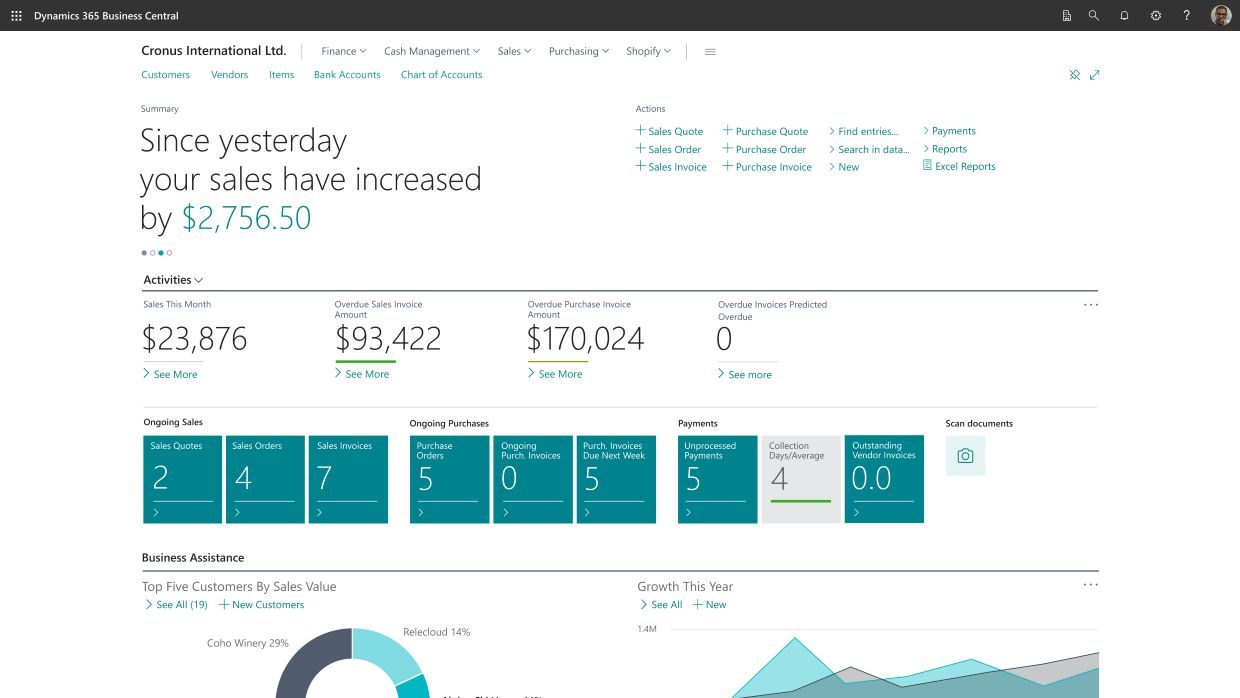
Business Central is Microsoft's ERP for small and mid-sized businesses, and one of SAP's strongest rivals. It integrates seamlessly with Microsoft 365, Power BI, and Teams, giving teams a single, familiar ecosystem.
Key features: financial management with budgeting and forecasting; inventory and supply chain visibility; project management and job costing; AI-powered insights through Copilot; low-code customization via Power Apps.
Pros: familiar Microsoft interface and fast adoption; quick cloud deployment; strong AI roadmap; transparent per-user pricing; scales from small business to mid-market.
Cons: deep custom workflows may need a partner; heavier manufacturing scenarios can require ISV add-ons.
Best for: SMBs and mid-market companies that want a scalable, cloud-first ERP with fast ROI — especially organizations already on Microsoft 365. See why Business Central is such a good fit for small businesses.
Deployment & pricing: cloud or on-premises. Starts around $95 per user/month — far below SAP.
Business Central vs SAP: where SAP is often too big and costly for smaller companies, Business Central delivers enterprise-grade capability without the implementation headaches or six-figure price tag. For a full head-to-head, read SAP vs Dynamics 365: which ERP is right for your business.
Watch a short walkthrough of Business Central in action:
This 17-minute demo shows the Business Central home experience, role centres, and how finance, sales, and inventory connect in one view — a useful first look at what a modern SAP alternative feels like day to day.

NetSuite was one of the first true cloud ERPs and remains a leader for global, finance-heavy businesses. Backed by Oracle, it specializes in multi-entity financial management and multinational compliance.
Key features: multi-subsidiary and multi-currency support (190+ currencies); tax compliance across 100+ countries; advanced financials, CRM, and e-commerce; real-time dashboards via SuiteAnalytics; pre-configured industry editions.
Pros: powerful consolidated financials; genuinely global; mature cloud platform.
Cons: premium pricing that climbs with add-on modules; customization can feel constrained; implementations are still substantial.
Best for: multinational and fast-scaling companies with complex financial and compliance requirements.
Deployment & pricing: cloud-only. From roughly $999 base + $99 per user/month.
NetSuite vs SAP: NetSuite rivals SAP's global reach with a leaner, faster-to-deploy cloud model. If you're weighing it against a Microsoft path, see our detailed comparison of NetSuite vs Dynamics 365 Business Central.

Acumatica is a cloud-native ERP built around flexibility, popular with growing SMBs that want customization without SAP-level consulting fees.
Key features: role-based dashboards and a clean UI; low-code/no-code customization; industry editions for distribution, construction, manufacturing, and retail; mobile-first design; consumption-based (not per-user) licensing.
Pros: resource-based pricing can be cheaper for large teams; very adaptable; strong for field and remote workers.
Cons: smaller partner network than Microsoft or Oracle; quote-based pricing reduces upfront transparency.
Best for: growing SMBs and mid-sized companies that need scalability and easy customization.
Deployment & pricing: cloud-only; quote-based, often resource-consumption pricing.
Acumatica vs SAP: Acumatica adapts to unique workflows quickly and affordably where SAP can feel rigid and expensive. We also invite you to read more about Acumatica alternatives if that is something that interests you.

Epicor is a veteran provider with a stronghold in manufacturing and distribution, offering deep vertical features SAP often needs add-ons to match.
Key features: advanced production and shop-floor control; inventory and supply chain management; distribution with demand forecasting; industry modules (automotive, aerospace, retail); cloud or on-premises.
Pros: strong manufacturing depth out of the box; proven in industrial sectors; flexible deployment.
Cons: interface feels less modern than cloud-native rivals; can require specialist support.
Best for: manufacturers and distributors that need industry-grade ERP. If that's you, our overview of ERP for manufacturing is a helpful companion read.
Deployment & pricing: cloud and on-premises; quote-based.
Epicor vs SAP: less complex but more specialized, with stronger manufacturing depth and faster ROI for industrial firms.

IFS is built for companies managing assets, services, and projects, excelling in field service and enterprise asset management (EAM).
Key features: field service management with mobile support; enterprise asset management; project lifecycle management; AI-powered analytics; focus on aviation, energy, utilities, and construction.
Pros: best-in-class field service and asset management; strong for project-centric businesses.
Cons: narrower fit outside asset/service-heavy industries; enterprise-level pricing and effort.
Best for: service-driven and asset-intensive businesses that need field operations visibility.
Deployment & pricing: cloud or on-premises; quote-based.
IFS vs SAP: IFS outperforms SAP in field service and asset management — two areas where SAP can feel overgeneralized.
How much could you save by switching from SAP?
Use our free Business Central ROI Calculator to model your real savings — implementation costs, licensing, and efficiency gains included.


Infor CloudSuite delivers industry-specific cloud ERP with AI-driven analytics and preconfigured verticals that speed up adoption.
Key features: vertical editions for manufacturing, retail, healthcare, and hospitality; multi-tenant cloud on AWS; prebuilt industry templates; advanced analytics; HR, supply chain, and CRM integration.
Pros: strong industry specialization reduces customization; faster implementation via templates.
Cons: breadth varies by vertical; still enterprise-grade cost and complexity.
Best for: companies that want ERP tailored to their industry rather than generic modules.
Deployment & pricing: cloud-only on AWS; quote-based.
Infor vs SAP: Infor's vertical pre-configuration often means lower customization cost and faster go-live than SAP.

SYSPRO is a focused ERP built specifically for manufacturers and distributors, with deep niche expertise.
Key features: manufacturing execution and planning; accounting and financials; inventory and warehouse management; reporting and analytics; cloud or on-premises.
Pros: affordable entry point; purpose-built for industrial workflows; no unnecessary bloat.
Cons: less suited to service or non-manufacturing businesses; smaller ecosystem.
Best for: mid-sized manufacturers and distributors.
Deployment & pricing: cloud or on-premises; starts around $35 per user/month.
SYSPRO vs SAP: delivers the manufacturing essentials at a fraction of SAP's cost.

Workday is best known for HR and finance, and has become a leader in cloud HCM — competing directly with SAP SuccessFactors.
Key features: human capital management (HCM); financial planning and analysis; payroll and workforce analytics; talent management; modern, mobile-ready interface.
Pros: best-in-class HCM and financial planning; excellent analytics; cloud-native and user-friendly.
Cons: not a full operational ERP (limited inventory, WMS, manufacturing); enterprise pricing; longer rollout for large orgs.
Best for: service organizations, education, and businesses where HR and finance are the priority.
Deployment & pricing: cloud-only; quote-based.
Workday vs SAP: a modern, user-friendly alternative to SAP specifically in HR and finance.

Odoo is an open-source, modular ERP that lets businesses build exactly what they need at a low cost.
Key features: 30+ modules (CRM, finance, supply chain, HR, marketing); open-source customization; cloud or on-premises; affordable enterprise edition; strong SMB adoption.
Pros: very affordable; highly modular; large community.
Cons: quality depends on implementation partner; community apps vary; can require developer resources.
Best for: small businesses and startups seeking flexibility at low cost.
Deployment & pricing: free community edition; enterprise from about $25 per user/month.
Odoo vs SAP: Odoo democratizes ERP — modular and affordable where SAP is costly and complex. (It's also a frequent answer to "what are the best SAP Business One alternatives" for very small companies.) We also invite you to read more about Odoo vs Business Central.

Unit4 focuses on people-centric industries such as professional services, nonprofits, and education, with strong project and financial management.
Key features: project and financial planning; HR and talent management; People Experience Suite; cloud-first architecture; specialization for nonprofits and higher education.
Pros: tailored to service and nonprofit sectors; simpler deployment; people-focused design.
Cons: limited fit for product/manufacturing businesses; smaller market presence.
Best for: professional services firms, nonprofits, and education providers.
Deployment & pricing: cloud-only; quote-based.
Unit4 vs SAP: goes where SAP doesn't — service-driven and nonprofit sectors, with simpler deployment and lower cost.
How to choose the right SAP alternative for your situation
The "best" SAP competitor depends entirely on what drove you to look. Use this as a shortcut to a shortlist:
- You're on Microsoft 365 and want fast ROI: start with Dynamics 365 Business Central.
- You're a multinational with complex consolidated finance: look at Oracle NetSuite.
- You need flexible, customizable cloud ERP for a growing SMB: evaluate Acumatica.
- You're a manufacturer or distributor: compare Epicor and SYSPRO (and Business Central with manufacturing add-ons).
- Field service or asset-heavy operations: prioritize IFS.
- HR and finance are your main pain points: consider Workday.
- You're a small business or startup on a tight budget: explore Odoo.
- You're a professional services firm, nonprofit, or school: look at Unit4 or Infor CloudSuite for vertical fit.
SAP pros and cons vs. competitors
The pros of SAP
SAP is trusted worldwide for a reason. Its ERP solutions cover nearly every business function: finance, HR, supply chain, analytics, and more. For multinational companies, SAP is particularly strong in compliance, supporting complex tax and regulatory environments.
Another advantage is integration power. Large organizations with intricate IT systems often choose SAP because it connects seamlessly across departments and geographies.
The cons of SAP
But these strengths come at a price. SAP is:
- Expensive: Licensing and implementation costs are among the highest in the ERP market.
- Complex: Deployments can take a year or more, often requiring dedicated IT staff.
- Harder to use: Employees face a steep learning curve, leading to slower adoption.
When SAP makes sense
- Large enterprises with global operations.
- Businesses needing broad compliance across multiple countries.
- Companies with deep IT budgets and resources.
When to choose a competitor instead
- SMBs that want affordable, easy-to-use ERP.
- Organizations in niche industries like manufacturing or professional services.
- Businesses that prioritize speed of deployment and ROI.
Ready to make the switch to Business Central?
Talk to a Gestisoft ERP expert and get a live demo tailored to your industry. We'll help you move from evaluation to decision with confidence.
 Free discovery call
Cost comparison: SAP vs. competitors
ERP pricing varies, but the gap between SAP and its rivals is huge.
- SAP S/4HANA: $150,000–$300,000+ implementation, with licenses around $1,000+ per user/month.
- SAP Business One: More affordable, but still costly once you add modules and maintenance.
Competitor benchmarks
- Dynamics 365 Business Central: From $95 per user/month.
- Oracle NetSuite: $999 base + $99 per user/month.
- Odoo: Free community version; paid plans from ~$25 per user/month.
In short, SAP often costs 5–10× more than competitors. For SMBs, that difference can make or break an ERP project. Total cost of ownership — not licensing alone — is what matters, so factor in implementation, training, and switching costs. To model your own numbers, our Business Central ROI calculator includes implementation, licensing, and efficiency gains.
What switching from SAP actually involves
Cost and features get the attention, but the migration is where projects succeed or stall. A realistic switch from SAP (or any legacy ERP) hinges on a clean data strategy, phased rollout, and change management. Two reads worth bookmarking before you start: the steps for building an ERP data migration strategy and the 5 ERP migration mistakes to avoid. Cloud-first alternatives like Acumatica and Dynamics 365 can go live in weeks rather than the year-plus a full SAP rollout often demands.
Benefits of choosing an SAP competitor
Choosing a competitor isn’t just about lower cost. Benefits include:
- Faster implementation: Cloud-first ERPs like Acumatica and Dynamics 365 go live in weeks, not years.
- Lower TCO: Subscription models replace heavy upfront licenses and reduce IT overhead.
- Ease of adoption: Modern ERPs focus on intuitive dashboards, mobile access, and user-friendly design.
- Industry fit: Vendors like Epicor (manufacturing) and Infor (healthcare, retail) tailor their systems to specific verticals.
- Continuous innovation: Competitors are often quicker than SAP to roll out AI, automation, and predictive analytics.
For many companies, these benefits outweigh the prestige of “going with SAP.”
The future of ERP beyond SAP
ERP is moving into a new era. Here are the trends driving competitors forward:
- Cloud-native ERP: Vendors like NetSuite and Acumatica have been cloud-first from day one. SAP is catching up, but cloud-based ERP competitors move faster.
- AI and automation: Microsoft Dynamics 365 leads with Copilot AIfor forecasting, workflows, and analytics. IFS and Infor are embedding AI into specific industries.
- Industry micro-ERPs: Niche providers are creating specialized solutions for sectors like construction, education, and nonprofits.
- User experience: Future ERP must be mobile-friendly, intuitive, and accessible for hybrid workforces. Competitors often outperform SAP here.
The bottom line: ERP is becoming leaner, smarter, and more industry-focused — and many SAP competitors are already ahead of the curve.
Gestisoft: a leading SAP competitor
While SAP is a leader in ERP, it’s not the best fit for every business. Many competitors now offer lower costs, faster implementations, and vertical-specific features that SAP cannot match.
If you’re evaluating ERP solutions, don’t assume SAP is your only option. By comparing functionality, cost, and industry fit, you may find that an SAP competitor is a better strategic choice.
At Gestisoft, we specialize in Microsoft Dynamics 365 Business Central — one of the most reliable and cost-effective SAP alternatives for SMBs and mid-market organizations. Our team helps you evaluate, implement, and customize ERP so you can focus on growing your business.
Contact Gestisoft today to learn how we can help you find the right ERP for your needs.
-
Microsoft Dynamics 365 Business Central, Oracle NetSuite, Acumatica, Epicor, IFS, Infor CloudSuite, SYSPRO, Workday, Odoo, and Unit4.
Liked what you just read? Sharing is caring.

June 22, 2026 by Kooldeep Sahye by Kooldeep Sahye Marketing Specialist
Fuelled by a passion for everything that has to do with search engine optimization, keywords and optimization of content. And an avid copywriter who thrives on storytelling and impactful content.