

Key Takeaways:
- Since 1 January 2024 a business filing six or more slips has to file them electronically, and the CRA applies a CAD $125 penalty for paper
- One T4 per employee means a payroll of six triggers the rule, where the old 50-slip threshold only ever caught large employers
- Canadian accounting software for small business has to handle GST, HST and the separate provincial taxes in BC, Saskatchewan, Manitoba and Quebec
- QuickBooks Desktop is closed to new subscribers in Canada and support for the 2023 release ended on 31 May 2026
- Dynamics 365 Business Central carries published Canadian pricing of CAD $108.50 per user per month for Essentials and CAD $149.20 for Premium
Canadian accounting software for small business has a CRA deadline built into it. Since 1 January 2024, any business filing six or more information returns has to submit them electronically, and paper filing above that line carries a CAD $125 penalty. The old threshold was 50 slips. Since every employee gets one T4, that puts the rule out of reach of any business with fewer than 50 employees.
Your accounting software has to produce a file the CRA accepts. A PDF you print out won't do it. That narrows the field to a handful of platforms, and they solve different problems.
Get the Canadian Requirements Scoped Before You Commit
Gestisoft has been implementing business software for Canadian companies since 1997.
 Free discovery call
The 6 best Canadian accounting software options for small business
Canadian small businesses mostly run cloud accounting now, and the platforms look alike on the surface. Payroll and inventory are what set the cost and the ceiling on each one.
1. Microsoft Dynamics 365 Business Central
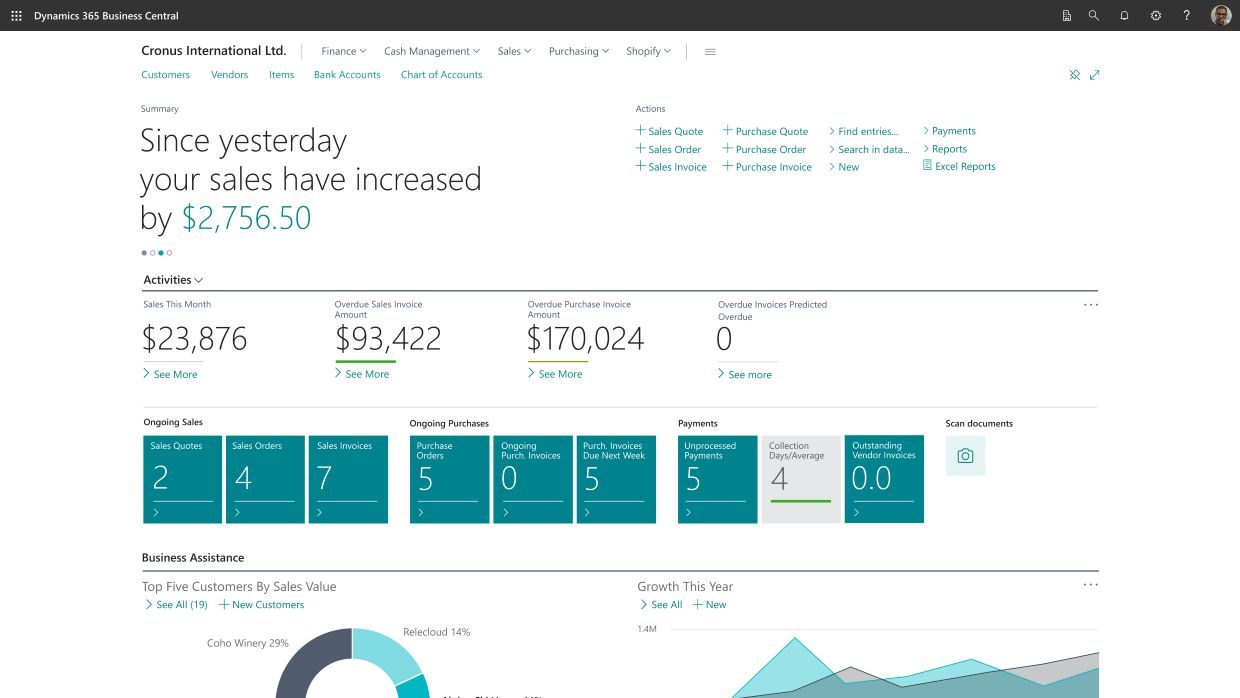
Business Central is Microsoft's ERP for small and mid-sized companies. Finance, inventory, sales and projects run on one data model, so there's no ledger at the centre of a ring of connected apps.
Pricing is published openly at this tier. Business Central pricing for Canada lists Essentials at CAD $108.50 per user per month and Premium at CAD $149.20, with a CAD $10.90 Team Members seat for read-and-approve staff.
What it does that the others don't:
- Runs multiple legal entities with consolidation built in, so a holding company reports across its subsidiaries without a spreadsheet
- Handles GST and provincial tax as separate jurisdictions inside one tax area, which is what BC, Saskatchewan and Manitoba need
- Carries manufacturing and warehouse modules in the Premium tier, covering production orders and bills of material
- Extends through code, so a requirement the standard product misses gets built in and survives updates
Business Central fits a business that has outgrown a single ledger. Business Central licensing is priced per named user, so the cost tracks the size of the team working in the system.
“The software is our working tool. With our previous solution, it was like having a stone hammer. We could accomplish our tasks, but the tool was outdated. With Business Central, if we decide to move into the Industrial 4.0 era, it's possible.”
Business Central accounting runs the ledger, and the same system holds the stock and the customer record without a second subscription behind either.
Licence pricing is published up front and the implementation gets scoped to the business, so a Business Central implementation cost figure follows from the work in front of you.
Ask Gestisoft what a Business Central build looks like for a company your size.
2. QuickBooks Online
QuickBooks Online is the platform most Canadian bookkeepers and accountants already work in every day. That familiarity cuts the year-end handoff down.
Intuit runs four Canadian tiers separated by user count, and where the top one stops is the accounting software vs ERP boundary.
- EasyStart, one user, income and expense tracking with invoicing
- Essentials, up to three users, adding bill management, time tracking and multi-currency
- Plus, up to five users, adding inventory tracking and project profitability
- Advanced, up to 25 users, adding custom reports and workflow automation
Every plan includes a free seat for your accountant that doesn't count against the user limit.
Set the tiers against a full Business Central modules list and inventory is the clearest difference. QuickBooks tracks quantity on hand and costs it out at the end. Business Central adds bills of material, production orders, warehouse locations and lot tracking, so a company that assembles or manufactures anything runs the whole chain inside one system.
What to consider before you pick it:
- QuickBooks Desktop is closed to new subscribers in Canada, and support for the 2023 release ended on 31 May 2026
- Payroll is a separate paid add-on, so the headline price isn't the T4 price
- Inventory starts at the Plus tier, which catches product businesses out on the cheaper plans
- User seats are capped per tier, so a team growing past five moves to Advanced
A QuickBooks to Business Central migration is the usual route once multi-entity reporting or deeper inventory becomes the requirement. Below that point the platform covers everything a single-entity business needs.
3. Xero
Xero charges by organisation, so every Canadian plan includes unlimited users at no extra cost. For a business where the owner and the bookkeeper both need access alongside staff, that model costs less than a per-seat competitor.
Three Canadian plans run from Starter through Standard to Premium, with Hubdoc receipt capture included on all of them. Businesses weighing it against the field will find accounting software alternatives to QuickBooks covers the same ground from the other direction. Xero raised Standard and Premium rates on 1 April 2026, so check the current figure on their pricing page.
Where it fits:
- Businesses running a large integration stack, since the app marketplace is the deepest in this category
- Teams who want everyone in the books without counting seats
- Multi-currency operations, which sit on the Premium plan
- Product businesses with light stock, though accounting and inventory management software for small business sets out where that stops
Two gaps matter in Canada. Canadian payroll runs through a third-party add-on. PST handling also has less depth behind it than the GST and HST support, and those tax codes attach to the chart of accounts, so a business in a PST province checks that mapping itself.
Business Central sets the provincial portion up as its own tax jurisdiction, which keeps the recoverable GST and the non-recoverable PST posting to separate accounts on their own.
4. Sage 50 Canada
Sage 50 is the direct successor to Simply Accounting, and it installs locally with cloud sync alongside it. Canadian businesses that want their data on their own machine still choose it for that reason.
Its strength as Canadian accounting software for small business is the compliance layer, which is why manufacturing accounting software shortlists still carry it. Payroll comes bundled in and CRA T-slips are native, with multi-province sales tax handled properly.
Inventory and job costing run deeper in Sage 50 than on the cloud-native platforms at the same price. Manufacturers and construction firms have stayed with it for that reason.
We also have a comparative video on Business Central vs Sage 50 that can help you in your Canadian accounting software solution hunt.
Four things need weighing before a Canadian business commits to Sage 50.
- Desktop deployment, so remote collaboration needs configuring before it works
- Fewer bookkeepers work in it daily than in the cloud platforms, which narrows the hiring pool
- Version updates and backups sit with you, since the install runs on your own hardware
- Multi-entity reporting that gets manual quickly, where Business Central consolidates across companies as a built-in step and a small business ERP does the work Sage leaves to a spreadsheet
Sage 50 alternatives come up when a firm wants that same compliance depth without the desktop. Most stay put until a second entity or a second warehouse appears.
5. Wave
Wave is free for core accounting and invoicing, and it's built in Toronto for North American small businesses. GST and HST tracking work without paying anything, which is rare. The dashboard puts invoicing and bank transactions on one screen, and for a business at this size that screen is the whole product.
For a sole proprietor or a consultancy under a few dozen transactions a month, Wave does the job properly. Double-entry bookkeeping, bank feeds, transaction categorisation and accountant-approved reports all fall inside the free tier, which is more than most free accounting software in Canada offers.
Where it runs out:
- Inventory is absent entirely, so product businesses are ruled out
- Multi-currency is thin, which catches anyone billing US clients
- Multi-entity reporting has no route at all, which is where Wave accounting alternatives become the conversation
- Payroll and payments are the paid pieces on top of the free tier
Wave is a starting point that businesses outgrow on a schedule, and the first employee is what starts the clock.
6. FreshBooks
FreshBooks was built in Toronto in 2003 for service businesses that bill by time or project, and the product still reflects that. Time tracking connects straight to invoicing, which no other Canadian platform does as cleanly. A project accounting module covers the same job for businesses that have outgrown it.
Its pricing works on active clients, so the tier you need follows how many people you invoice. That model suits agencies and trades, and an accounting software consultant will flag it early for a business with a long client list and small invoices.
The full picture:
- Strongest option for hourly billing and project profitability
- Phone support available, where Xero handles Canadian queries by ticket
- No inventory at all, where Business Central holds stock, bills of material and production orders in the same ledger
- Lighter on double-entry depth than QuickBooks or Xero, which some accountants dislike
FreshBooks fits a consultancy or an agency that invoices by the hour and carries no stock.
Bring Your Own Requirements to the Conversation
Gestisoft implements Business Central and Dynamics 365 CRM under one roof.
 Free discovery call
What Canadian accounting software for small business has to handle
Four obligations decide whether a platform qualifies, and each one comes out of Canadian law.
1. How does the CRA six-slip rule affect your software choice?
The Canada Revenue Agency requires any business filing six or more information returns to file electronically. The software has to produce a CRA-compliant file or transmit directly, and T4, T4A, T5 and T3 all count toward that total. From January 2025 the CRA requires one type of return per file, so T4s travel separately from T4As.
A platform that generates T4 slips as PDFs for printing has solved the wrong problem. What the CRA wants is XML, and automating the accounting process at year end depends on the software producing it without a manual step.
2. Which sales taxes does Canadian accounting software for small businesses need to support?
GST and HST are the baseline, and four provinces charge their own tax on top. British Columbia, Saskatchewan and Manitoba each run their own provincial sales tax. Quebec adds QST, with its own registration and filing.
The distinction is financial. Input tax credits recover the GST and the provincial portion stays a cost. Software treating provincial tax as a second rate on the same line produces a return a controller corrects by hand every quarter.
3. What does a business need for its year-end handoff?
Your accountant needs a trial balance they can map to GIFI codes for the T2 return, and slips that reconcile to the ledger they came from. Canadian accounting software for small business gets judged on that handoff more than on its feature list.
Four things should come out of the software without a rebuild.
- A trial balance that maps cleanly to GIFI codes
- T4 and T4A slips that reconcile to the payroll ledger
- GST and HST return figures that tie back to the sales ledger
- Bank reconciliations completed through to the year end date
An accountant who has to rebuild your chart of accounts will bill you for every hour of it. A financial management system that exports cleanly cuts a two-week close down to two days.
4. Does the software need to work in French?
For a business with staff or customers in Quebec, yes, and it reaches further than the interface. Customer-facing documents have to exist in French, which reaches invoices and statements as well as the menus.
Most cloud accounting platforms offer a French interface. Fewer produce bilingual customer documents from the same data without a workaround.
Where AI has changed Canadian accounting software for small business
Bank reconciliation is the task AI reached first, because matching a bank line to a ledger entry is pattern work and the pattern repeats every month. Every platform in this category now advertises something under that banner, and the claims need separating from the behaviour.
QuickBooks ships Intuit Intelligence across its tiers, covering transaction categorisation and anomaly detection that flags discrepancies before anyone opens the file. Copilot in Business Central proposes the matches on a reconciliation, and the person running the close approves each one, so a human signature stays on every posted entry.
Two things separate a useful AI feature from a demo.
- Canadian bank feeds need supporting to the same depth as US ones
- The output either waits for approval or posts on its own
Approval rights decide how much of the close a finance team can hand over. AI in ERP traces where that line has moved to, and bank reconciliation in Business Central is the manual version the AI works from.
When Canadian accounting software for small business stops being enough
Entry-level platforms stop at the ledger, and the signals that you've passed the edge are consistent.
- One person types the same information into two systems every week
- Month-end runs past the first week because figures come in from several places
- Inventory on the system disagrees with inventory on the shelf
- A second legal entity appears and the consolidated numbers get built in Excel
- Reporting the board asks for needs a field the software has no room for
A margin by product line or a breakdown by cost centre leaves an entry-level platform as a spreadsheet export, and it stays accurate only as long as that export does. Analysis mode in Business Central pivots the same figures inside the ledger, so the numbers are current every time someone opens them.
Moving to a different package at the same tier leaves every one of those in place. Canadian accounting software for small business is built for the ledger, and these are operational problems standing outside it. They mark the point where accounting software for enterprise scope becomes the conversation, and an ERP system for small business is what waits on the other side.
Timing works in your favour if you plan it. Starting fresh on the first day of a fiscal year means no comparative reporting across two systems, and the ERP implementation phases before that date are where slip generation gets tested.
The move costs more than the licence does, so budget for it. ERP pricing and the service work behind it decide the total, and a migration to Business Central gets scoped separately from the subscription.
Talk to a Microsoft Partner About the Move
Gestisoft holds Microsoft Solutions Partner status for Business Applications.
 Free discovery call
How Gestisoft implements Canadian accounting software for small business
Gestisoft has implemented business software for Canadian companies since 1997 and holds Microsoft Solutions Partner status for Business Applications, delivering Microsoft Dynamics 365 Business Central in Canada across the country.
Five things get settled during discovery, before a single transaction posts.
- The tax jurisdictions, with the provincial portion held separately from the recoverable federal side
- The chart of accounts, mapped so the T2 return comes off it without a rebuild
- Slip generation, tested against the CRA file format ahead of the first year end
- The dimensions the board reports on, fixed before anything is coded to them
- Anything the standard product misses, written as an extension Gestisoft maintains itself
“Gestisoft had a knack for finding creative solutions. It wasn't easy, but the team never gave up and always managed to come up with solutions while trying to reduce costs as much as possible and bearing in mind the solution ecosystem's durability.”
Few Canadian partners run an ERP practice and a CRM practice together. Gestisoft runs both, so a quote raised in Dynamics 365 CRM and invoiced in the finance system crosses one handover with a single owner. Business Central CRM integration means the order details get entered once.
Delivery runs in English and French, and tenants deploy into Azure's Canadian regions. A Customer Success Manager picks up the account at go-live and stays on it. Month one produces questions from staff who never attended a workshop, and the people who built the configuration are the ones who take them.
“As a customer since 2015, I would like to highlight the quality of support and expertise provided by Gestisoft for our Business Central application. Their competence is notable and has greatly contributed to the success of my business.”
Business Central support services run from the same team that did the build, and an ERP migration carries the opening balances and the transaction history across. The first filing on the new system reconciles to the last one on the old, and the consultants who configured it are still on the account when that filing goes out.
-
It depends on how the business is built. A solo operator gets everything they need from Wave for free, a service business billing hourly suits FreshBooks, and a product business with staff ends up on QuickBooks Online or Xero. Canadian accounting software for small business stops being enough once a second entity or real inventory appears, and Business Central is the step after that.
Liked what you just read? Sharing is caring.

September 13, 2026 by Shelley Sunjka by Shelley Sunjka Copywriter & Marketing Strategist
Armed with a psychology degree and an irrational obsession with okapis, I've spent the last decade helping bold brands tell better stories. I believe the best writing bends grammar rules on purpose and makes people feel something. When I'm not deep in words or nerding out on buyer behaviour, I'm probably convincing my kids that impromptu kitchen dance parties are totally normal.
